|
|
Blood Tracking dogs and training
by André Brun

LED headlights and flashlights for tracking:


(I am planning some major updates here,
but it takes time for me to translate it all to English.)


"The true "crown" of all dog-dom is blood tracking."

Training the young dog
You may start the young dog as soon as he's in the house. But what you do in the beginning is just to get him interested and begin to establish a good method of tracking, which in our case meens with a deep nose.
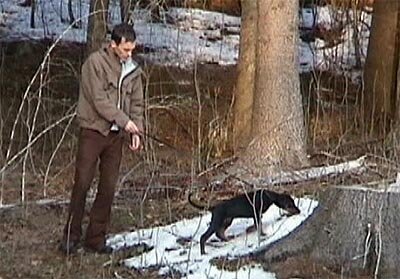 Begin the training by letting the dog track short tracks of for example a short blood track on a field without vegetation, or family member - an object he has motivasion to track down and find. Lay the track on for example a soft dirt field without vegetation or just short grass. Vegetasion has the ability to hold scent for a period of time - and we don't want the dog to follow the scent kept above the ground when we start a dog. No, we want him to establish a calm style of tracking with a very deep nose. The soft dirt field or the short sparse grass field keeps the scent information in the actual foot steps, so to follow the track the dog has to use a deepest possible nose. Dogs are creatures of habit, so starting this way establish a style that the dog will use for the rest of his life. And make it all a funny game to the dog in the beginning. Begin the training by letting the dog track short tracks of for example a short blood track on a field without vegetation, or family member - an object he has motivasion to track down and find. Lay the track on for example a soft dirt field without vegetation or just short grass. Vegetasion has the ability to hold scent for a period of time - and we don't want the dog to follow the scent kept above the ground when we start a dog. No, we want him to establish a calm style of tracking with a very deep nose. The soft dirt field or the short sparse grass field keeps the scent information in the actual foot steps, so to follow the track the dog has to use a deepest possible nose. Dogs are creatures of habit, so starting this way establish a style that the dog will use for the rest of his life. And make it all a funny game to the dog in the beginning.
Lay the blood drops with the distance of short foot steps (or with the same distance if you are using a blood laying stick to lay the track). The dog isn't actually learning to track a BLOOD TRACK, but rather to track a TRACK. Of course, a wounded animal isn't bleeding all the time, so instead of tracking the blood, the dog is tracking the scent of the wounded animal or the strong scent of the hooves.
Lay the track downwind to further eliminate that the dog is air scenting. Laying a track downwind forces the dog to work with a deep nose.
 Some general tracking tips to keep in mind: Some general tracking tips to keep in mind:
- Never track too fresh tracks when the dog is in the early learning phase. The older tracks forces the dog to work harder, more accurate and slower to progress.
- Walk downwind when laying the track. Then you force the dog to lower it's nose to get the ground sent, and not just running down the line with a high nose.
- Stop at once if you see the dog tends to raise its nose - the dog may only progress if he's lowering his nose. He'll quicly learn this if you are consequent.
- Walk slowly and don't talk and praise the dog all the time. It's distracting and not necessary - his reward is the progress in the tracking itself.
- Lay the track where there are little or sparse vegetation. The line of scent particles will fasten low to the ground in the actual track, and force the dog to learn to track with a deep nose.
- Don't be afraid of a lot of angles in the track. Then the dog learns to be accurate and not just run strait ahead.
- Never help the dog - let him learn to solve the problems himself. We have no use of a dog that stops and look at the handler each time it gets difficult.
I've written an article on blood tracking for Leerburg.com and you may find it here.
BLOOD TRACKING
by André Brun
Using dogs to help find wounded animals is an old technique that has its origin in Europe. But in North America also, dogs were used by the early white inhabitants to find wounded big game. The basis for this was the realization that dogs are superior to man in following faint trails with little or no visible blood. At first there were probably no ethical motivations and specialized dogs were used to recover wounded game simply because this produced more meat and hides.
 Today, most hunters take great pride in recovering their wounded game. Of course, one reason is food, but most important is the ethical concern that an animal should not suffer unnecessarily. The decision to use a tracking dog is above all an ethical one. So when hunting one should strive to minimize the suffering of a wounded animal, and this is best achieved by having a highly trained and specialized blood tracking dog. Today, most hunters take great pride in recovering their wounded game. Of course, one reason is food, but most important is the ethical concern that an animal should not suffer unnecessarily. The decision to use a tracking dog is above all an ethical one. So when hunting one should strive to minimize the suffering of a wounded animal, and this is best achieved by having a highly trained and specialized blood tracking dog.
In this context, it is interesting to mention that in Norway, my own country, all hunters must have access to an officially titled and registered blood tracking dog in order to get permission to hunt roe deer, red deer and moose. And as a result of this, there are many blood tracking dogs and a lot of people involved in training and judging tests and competitions.
Today, blood tracking dogs also do an important job when animals are hit by cars every day around the country. To find a wounded roe deer, red deer or moose, which has been hit by a car and has run out of sight into the woods, may be as difficult a task as anything encountered in hunting season. Hunters and dogs do an excellent job of reducing the suffering of wounded animals.
The test to become a titled blood tracking dog in Norway or ettersøkshund as we call it consists of two parts. The first part is to follow a fresh track of a roe deer, red deer or moose for at least half an hour and the second part is to track a 600 meter blood line laid with 90 degree turns, a couple of ten meter gaps in the blood line, a wound bed and so forth. We use 0,3 litres of blood for this distance, and the track should be 12-24 hours old and laid in a varied, wooded terrain. There are many rules concerning the judging and certification of a dog, but I wont go into the details in this article. I will mention though that the judgment and rules are always based upon the assumption that a dog and handler must work satisfactorily as an effective team during real work. I will point out that passing this blood tracking test establishes the dog with a title as an officially registered dog. But this is just the first step. It is after this point that the advanced training takes place. Most hunters settle at this level and train some now and then and thats fine. Some hunters also advance into more complicated training steps and develop their dogs even more.
An experienced blood tracker and breeder, John Jeanneney, points out that the North American approach is to train the dog more through natural experiences on the scent lines of real wounded deer once the basics have been learned on artificial blood lines. Beyond the entry level, dogs develop their expertise through natural tracking. The European approach, with an emphasis on formal training and tests, makes good sense in the European context.
 Tracking dogs must learn to track faint, day-old scent lines of wounded animals for long distances in varied terrain. The animals may have run at full speed if frightened, and they may have bled very little; it is important that the dog be able to handle weak scent lines. At the same time, it is essential that the dog learn to ignore the fresher scent of healthy animals that have crossed the tracks of the wounded one. If a dog runs off because it finds the fresher tracks more tempting, the dog is worth little at that moment and needs more training. Sometimes this may be a problem with certain dogs, but it is nothing so serious that a good trainer cannot resolve it in a short time. Tracking dogs must learn to track faint, day-old scent lines of wounded animals for long distances in varied terrain. The animals may have run at full speed if frightened, and they may have bled very little; it is important that the dog be able to handle weak scent lines. At the same time, it is essential that the dog learn to ignore the fresher scent of healthy animals that have crossed the tracks of the wounded one. If a dog runs off because it finds the fresher tracks more tempting, the dog is worth little at that moment and needs more training. Sometimes this may be a problem with certain dogs, but it is nothing so serious that a good trainer cannot resolve it in a short time.
One can never be one hundred percent certain that a shot was a miss when the animal runs out of sight. Thats the reason why the dog and handler are judged also by their abilities to follow the fresh track of a healthy animal. The deer doesnt necessarily show any signs of a hit, and you have to track the animal for some distance to be sure that it is unwounded and all right. This is why we automatically put the specialized blood tracking dog on the track after an hour or two (the waiting is due to the fact that a wounded animal will lie down much sooner if not followed). Signs of blood are not a safe way to determine if an animal is wounded or not.
Blood tracking with dogs today has become a sport and hobby for many hunters, but it is also a necessity when hunting. So, this inner motivation that hunters have to train and develop a reliable blood tracking dog, for the fun and challenge of doing it, has had an important result. There has been an enormous gain in knowledge and expertise over the last decades; the refined training techniques and the specially trained dogs, used only for blood tracking, have increased the effectiveness of the searches for wounded game. A lot of hunters still use their hunting dogs also as a blood tracking dog its convenient, but its not a good idea. A hunting dog (lets say a Norwegian Elkhound) that has tracked moose all day long off-leash isnt exactly a fully rested and highly motivated dog to put on a leash for a long and difficult blood tracking job in the evening. It will not perform at its best when it has already done a full days job. So in this context, I believe theres a great niche for the working type breeds like the GSD, Malinois, Belgian Sheepdog and Doberman when it comes to tracking wounded game. Not as hunting dogs, but as highly trained specialists when theres need for a good blood tracking dog.
-------------------------------------------------------------------------
More on blood tracking
 Ulv was with us on every hunt as tracking dog. And the fall 2000 he'd already been involved in the hunting of 12 roe-deers and a moose. We've had some great situations pyrsch hunting and Ulv is as silent as a shadow. And when he's needed for tracking he's always by my side. I guess not many breeds can stay silent like this for as much as an hour or two - but the Groenendaels seems really special this way. Not that they are lazy - quite the opposite because they are like an explosion when given a command (look at French ring results) Not to brag about this breed, but they seem to have a human like sense of what's going on. Of course Ulv's trained to act exactly like this in certain situations, but I've often watched him sitting there next to me for tens of minutes and he's not even moving a foot when the Dachs is on the track of a roe-deer somewhere downhill in the woods. He's got a remarkable sight and just sits there and stearing and using his nose to the fullest - reading every sign of the developement in the hunt... Ulv was with us on every hunt as tracking dog. And the fall 2000 he'd already been involved in the hunting of 12 roe-deers and a moose. We've had some great situations pyrsch hunting and Ulv is as silent as a shadow. And when he's needed for tracking he's always by my side. I guess not many breeds can stay silent like this for as much as an hour or two - but the Groenendaels seems really special this way. Not that they are lazy - quite the opposite because they are like an explosion when given a command (look at French ring results) Not to brag about this breed, but they seem to have a human like sense of what's going on. Of course Ulv's trained to act exactly like this in certain situations, but I've often watched him sitting there next to me for tens of minutes and he's not even moving a foot when the Dachs is on the track of a roe-deer somewhere downhill in the woods. He's got a remarkable sight and just sits there and stearing and using his nose to the fullest - reading every sign of the developement in the hunt... 
During a hunt in Sweden that fall Ulv was with us as the tracking dog. We hunted together with some Swedish and Danish hunters for roe-deer and moose. One of the days a hunter was unlucky and wounded a roe-deer and had to send for me and Ulv. When we arrived from the other side of the forrest I waited for a while so that the roe-deer would lay down and get what we call "sårfeber". Then I said "finne!" to Ulv, and he was on the job. Some minutes later Ulv had lead me to the roe-deer which was already dead. A happy ending, but without the dog I am certain that we would not have been able to find it in the thick and heavy bushes.

It's important to have access to a trained dog. Even a perfect hit roe-deer can run quite a distance, ecpesially if it's full of adrenalin and on the run. Without a dog the roe-deer may be hard to find if it has crossed the tracks of other roe-deers or ran through rough an bushy terrain (The roe-deer on the picture was shot too far away from its vital organs as you may see, and did run some.).
When hunting roe-deer, we're in a large terrain with very few others. But even if the terrain is large we try not to disturb them to much and use small Dachs dogs in the actual hunt. The Dachs is slow and are not capable of chasing - just following some minutes behind. Very efficient when hunting - the slower the better.
I've also hunted roe-deers with vorsteh - which is a lot of fun - but they are just too quick. The roe-deers get nervous and sometimes just run "straight out", meaning they don't go rounds, but just head for the horizon...

 A couple of 2001 tracking stories: A mediocre hunting season - some roe-deers, grouses, fox and a reindeer (It's only december when I write this, though). Ulv had to track a fox I shot and a roe-deer I THOUGH he had to track. A couple of 2001 tracking stories: A mediocre hunting season - some roe-deers, grouses, fox and a reindeer (It's only december when I write this, though). Ulv had to track a fox I shot and a roe-deer I THOUGH he had to track.
A Fox: I was sitting beside a tree with Ulv as usual (in the middle of the week, in the middle of "nowhere"), when a fox came running fast out from a dense wood (far away from the barking dachs which was on the track of a roe-deer). It was a dense and difficult place and I only saw the back of the fox, so I just followed him with my rifle scope to see if I might get a better view of him. No need to risk anything - a fox is a respectable animal, as all other animals, and I don't want to send of a shot just to...I've hunted too long to do that kind of things. 
But. Suddenly he ran across some meters of open space and I gave it a try. The fox clearly hit well, ran into the dense bushy area, and I stood there and watched him (with a sad look upon my face, I guess), because he was hit too well to run that far (but you know how far an animal can run after a shot if he's "on the run") Anyway, I could see by the way he ran that he was hit, so when the two hunters with the dachs passed by I told them that they could just walk on by back to the rendez- vous and wait. I waited by the tree for a while with Ulv and then put on his harness - and started tracking.
Ulv's nose dropped to the ground about where I had shot at the fox. Then he guided me about 70 meters into a dense wooden area where the fox suddenly had turned 3-4 meters and laid down under a bush. I garantee that I had never found the fox without the help of the dog - so dense was this area (you who think you can track as good as a dog, get real - or watch a good tracking dog in action ;-)) Luckily, the fox was already dead - a fine specimen - and a true roe-deer killer as well.  In both Sweden and Norway, there seems to be too many foxes and they're really tough on the roe-deer and hare populations, so there is a nescessity to shoot some of them. A friend of mine, which is an experienced hunter as well and honestly have nothing against the fox (who has?) say that in his area the larger experienced foxes kill about 80% of the roe-deers during their first year. I think the red fox are among the most adaptable and effective animals in the Scandinavian fauna and I really respect them for being so perfect in their habitat. On the picture you can see the fine red fox. In both Sweden and Norway, there seems to be too many foxes and they're really tough on the roe-deer and hare populations, so there is a nescessity to shoot some of them. A friend of mine, which is an experienced hunter as well and honestly have nothing against the fox (who has?) say that in his area the larger experienced foxes kill about 80% of the roe-deers during their first year. I think the red fox are among the most adaptable and effective animals in the Scandinavian fauna and I really respect them for being so perfect in their habitat. On the picture you can see the fine red fox.
A roe-deer: I'd sent Ulv away with the dachs and the hunter who was going to search the area. And just as I'd selected an opening in the terrain where I'd thought the roe-deers might come running - there came two of them. And fast! I saw the first one in a split second, let it go and shot the second at 5 meters range in full speed (the yearling) with my rifle. I was sure it was a good shot, but he ran away out of sight. Ulv came out from the woods about 10 seconds later  (remember what I've said about hunting roe-deers with Vorsteh earlier - and the Groenendael is even much faster.) I managed to stop him and put on his harness. And I didn't care to wait for an hour or more, because I was sure the roe-deer laid in the woods somewhere in the nearby. Dead. So I sent him on the track with a "finne" command. It was so dense that I wouldn't start without him, but the roe-deer had only ran for about 30 meters or so, so Ulv found him right away. But you never know... (remember what I've said about hunting roe-deers with Vorsteh earlier - and the Groenendael is even much faster.) I managed to stop him and put on his harness. And I didn't care to wait for an hour or more, because I was sure the roe-deer laid in the woods somewhere in the nearby. Dead. So I sent him on the track with a "finne" command. It was so dense that I wouldn't start without him, but the roe-deer had only ran for about 30 meters or so, so Ulv found him right away. But you never know...
On the other hand: In my opinion, one should use a tracking dog even when you are "sure that you've missed". Every time. Every time. Every time. I don't know if this is basic in i.e the US (correct me if I'm wrong: E-mail me), but a good tracking dog should also be able to track even a healty animal for a long distance and this makes you able to follow and assure that you did not hit it at all. An animal might not start to bleed at once and might not show any sign of a hit as well. So make it a rule for yourself: Track even if you are sure you didn't hit it. 
There is a lot of hunters in Norway and there's a reason why all Norwegain tracking dogs have to go through a second test: Not only the important blood tracking, but also a long distance tracking of a healthy roe-deer, moose or deer. All of us who are into tracking dogs are responsible hunters that not only track because we want to find our pray, but also because we don't want any wounded animals to be left in the woods.
For further info in the US on tracking and regulations, please visit deersearch.org, Jolanta and John Jeanneney: www.deersearch.org
Any questions, stories etc. please visit TrackingDogs MessageBoard and share it with others - it's always interesting to hear about others experiences.

Sure smells good...
-----------------------------------------------------------------
TRACKING TRAINING STORY
Had a funny training session just prior to the hunting season summer 2000:
I laid a track and had planned it to be somewhat hard for my young Groenendael, Ulv - a track that he had to work with because it was difficult, but not long.
I used 0,2-0,3 liters of cow blood on a track that was about 600+ meters long. Small drops here and there. It laid all the 10 meters stops in an angle with no blood (to simulate the blood stop on a running animal), a wound bed and I laid it over fields, through some dense bushes, out on a grassland and finally ended it in a wooden area. At the end some roe deer ribs (the ultimate reward for Ulv :-). Then I waited for about 24 hours to let the track age a little.
But during the night it rained heavily. Heavily for many hours and the next day, I thought that "well, this track's probably ruined". Anyway, I decided to let Ulv give it a try.
He started of super focused as usual as I showed him his tracking harness. He gave me this "André, we really have a great time when tracking"- look and I said that "Ulv, I will not be dissapointed if you can't find those roe deer ribs tonight, because no wounded animal'll ever be that hard to find".
Cow blood is "boring" to the dog compared to smelly roe deer blood or the track of wounded game, but it was the heavy rain that conserned me most - the track was gone.
Rain may be good if it's just in small or medium amounts, also if there has been a dry period. Then the humidity will actually help the dog. But very heavy rain for many hours isn't good when using small amounts of cow blood. Then the track gets washed away to some degree, when it's a already "weak" track, with little blood and no strong sent of a deer, roe deer etc.
I led him up to where I had started laying the track the previous day and said "finne!" as usual. Bam! His nose dropped to the ground like a magnet where I'd dropped the extra drops of blood and kicked up the dirt, to simulate the start of a shot and accelerating animal. But them it got harder.
 There where no track from the kicked-up-dirt- spot and Ulv circled with a serious and conserned body language around the spot to try to find the track of the "running animal". I gave him all the meters of the rope as I stood there, and watched him circling systematically around the spot in wider and wider circles, back to the spot again and then circling wider and wider...All of the time he now and then gave me this split second look that I know he uses to tell me "I am not sure where the track goes at this moment André!!!". There where no track from the kicked-up-dirt- spot and Ulv circled with a serious and conserned body language around the spot to try to find the track of the "running animal". I gave him all the meters of the rope as I stood there, and watched him circling systematically around the spot in wider and wider circles, back to the spot again and then circling wider and wider...All of the time he now and then gave me this split second look that I know he uses to tell me "I am not sure where the track goes at this moment André!!!".
Then he suddenly stopped. I could really see him thinking hard when he stopped for a moment and raised his head - just to stand there and evaluate the situation. Then his nose dropped to the ground again, and Ulv, determined as ever before gave it a new 100% try and I could almost see by the look of him that he really evaluated every particle of sent on the ground this time. Then we started walking - slow.
Ulv, was suddenly on the track, but this time he was even more focused than I've ever seen him before. It was a tough nose job to go all the way on this rained away blood track with long blood stops and all, but there, Ulv, slowly, but determined guided me through the bushes, over the grassland and over the usual 10 meters of blood stops and into the woods again. And finally, with the excited body language of a happy dog, he sat his teeth in, and showed me the roe deer ribs hidden under a bush.
When training I usually take the animal hide, ribs, meaty bones or whatever I use as an item at the end of the track away from him after a while, just to keep it a rule that "the animal isn't something you eat by yourself in the woods", but this night I let him carry the ribs all the way back to our cabine to eat. With his tail high up in the air he was running proudly around me all the way back giving me this "God, we are great"- look, and now and then stopped in front of me and let me hold and take a look at this hard to find "wounded animal".
But I realize that I am not the great one in this context. The real hero, when someone is unlucky and are wounding an animal, is the experienced tracking dog.
André Brun
|

|
|
The Groenendael Ulv, when he was judged to a 1. prize at the exame at the age of 20 months.
|


--------------------------------------------------------------------------------------
| Official tracking dog in Norway |
 |
To become an official tracking dog for moose, deer and roe-deer in Norway, the dog and handler has to go through two tests. Of course these tests are just the beginning of a tracking dog, but they are important in the matter that they focus on the basic skills of the dog, both for fresh tracks and blood tracks and the cooperation with the handler. The experience is achieved only by tracking wounded animals: |
|

|
Part 1: Blood tracking: The scheme used for training is 600 m. in normal rough terrain. We use 0.3 litre of blood spread out along the track and it should be 12-24 hours old. It consists of 4 angles (and those that comes natural of the terrain) and 2 blood stops for 10 m. - one in an 90° angle, and a simulated stop of the wounded animal. At the end of the blood track we always used to hide a foot of a roe-deer or similar. |
 During the test the judge is noticing several thing such as the collaboration between the dog and the master, the dogs capabilities and will to follow and search, how he does it, the right speed of the dog so that the following shooter can walk comfortably and silent by the side, that the dog never must leave the original track if he finds a fresher track and a lot more. If the dogs fail in any of this and more he'll be disqualified. During the test the judge is noticing several thing such as the collaboration between the dog and the master, the dogs capabilities and will to follow and search, how he does it, the right speed of the dog so that the following shooter can walk comfortably and silent by the side, that the dog never must leave the original track if he finds a fresher track and a lot more. If the dogs fail in any of this and more he'll be disqualified.
Part 2: Fresh track: From either a moose, deer or roe-deer. The dog has to follow the track for at least half an hour to an hour, and the track must be at least one hour old. An early morning track from an animal is suitable to track in the afternoon.


"Aequam memento rebus in arduis servare mentem" - "Remember to keep
a clear head in difficult times" Horace


|
|

|
|
From 1914.
The Groenendaels Zig and Lary's tracking a 3 km. long and 10 hours old track in Belgium.
|
|
|
|
Video clips
|
 |
 |
Ulv is tracking down a wounded roe-deer (3.7 mb).
This is a really easy one with a heavy scent trail, though. |
The tracking dog and a moose (3.2 mb). |

Start of track - instructional training routine clip |
Lokes first track!!
The new puppy on his first track at the age of 8 weeks
(Filstørrelse, 2,4 mb)
|
|
(Right click and save to harddisk before viewing)
|
|
LINK
|
|
TrackingDogs Message Board
|
|
Click the link above or the logo to enter the TrackingDogs Message Board, for
|
|
discussions, questions, sharing experience and views on blood tracking and dogs.
|
|
|
| Hosted by HostedScripts.com |
"Tracking, of all dog sports, is the most mysterious to trainers while,
seemingly the most natural to working dogs."
 to the main dogs page. to the main dogs page.
|


